Acquiring new customers is essential for business growth, but growth comes at a cost. Businesses invest in advertising, content creation, marketing technology, sales teams, and other activities to attract potential buyers. The challenge is understanding whether that investment generates enough value to justify the expense.
Customer Acquisition Cost (CAC) measures how much a business spends, on average, to acquire a new customer. By tracking CAC, companies can evaluate marketing efficiency, compare acquisition channels, and make better decisions about where to invest their budgets.
In this guide, we explain how to calculate customer acquisition cost, explore practical examples, and identify strategies to improve acquisition efficiency.
What Is Customer Acquisition Cost?
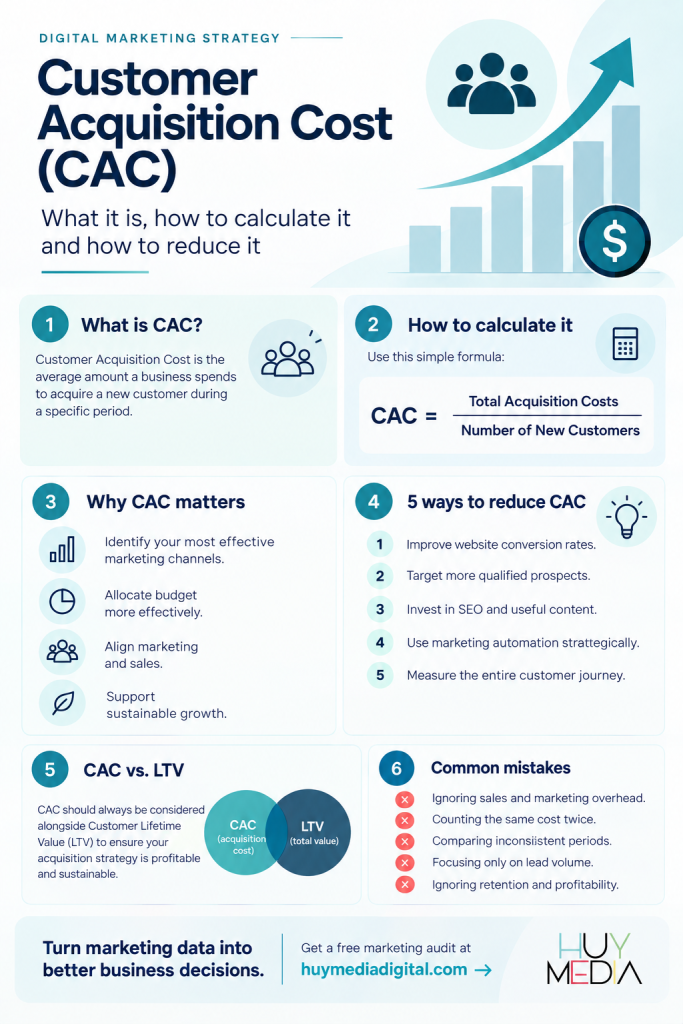
Customer Acquisition Cost is the average cost of converting a prospect into a paying customer during a specific period.
Depending on the business model, acquisition costs may include:
Paid advertising on Google, LinkedIn, or Meta.
Marketing agency fees and campaign management.
Content production, SEO, and social media marketing.
Marketing software, CRM platforms, and automation tools.
Sales salaries, commissions, and prospecting expenses.
Other costs directly associated with acquiring customers.
CAC provides a broader perspective than advertising metrics alone. A campaign may generate inexpensive leads but still have a high acquisition cost if very few leads become paying customers.
How to Calculate Customer Acquisition Cost
The basic formula is:
Customer Acquisition Cost = Total Acquisition Costs ÷ Number of New Customers Acquired
To calculate CAC, select a period, add the relevant acquisition expenses, and divide the total by the number of new customers acquired during that period.
For meaningful comparisons, use a consistent methodology. Decide which marketing and sales expenses to include, avoid counting the same cost twice, and account for differences in sales cycles.
Example 1: A B2B Marketing Agency
Imagine a B2B company invests $8,000 in customer acquisition during one month.
Its expenses are:
| Acquisition activity | Monthly cost |
|---|---|
| LinkedIn and Google Ads | $2,500 |
| Content marketing and SEO | $1,500 |
| Marketing software | $500 |
| Sales salaries and prospecting | $3,500 |
| Total | $8,000 |
During that period, the company acquires 16 new customers.
CAC = $8,000 ÷ 16 = $500 per customer
The company spends an average of $500 to acquire each new customer.
Is that a good result? It depends on what those customers generate in revenue and gross profit, how long they remain customers, and how quickly the business recovers its acquisition costs.
If the average customer generates $2,000 in monthly revenue, the acquisition economics may look attractive. However, revenue alone is not enough: delivery costs, margins, retention, and cash flow must also be considered.
Example 2: An E-commerce Business
Consider an online store that sells products directly to consumers.
Over one month, it spends $6,000 on advertising, creative production, marketing tools, and other acquisition activities. During the same period, it acquires 120 new customers.
CAC = $6,000 ÷ 120 = $50 per customer
If the store’s average first order is worth $80, it might appear that the acquisition strategy is profitable. But the business must also account for product costs, shipping, payment processing, returns, and other expenses.
Suppose the gross profit from the first order is $32. The store spends $50 to acquire a customer but earns only $32 in gross profit from that first purchase.
It has not yet recovered its acquisition cost. Repeat purchases may make the customer profitable over time, but the business needs to measure retention and repeat-purchase behavior to confirm that assumption.
This example shows why CAC should always be evaluated alongside customer profitability and lifetime value.
Why Customer Acquisition Cost Matters
1. Identify Your Most Effective Marketing Channels
Different channels can produce very different acquisition costs.
For example, a company might acquire 10 customers through paid advertising at a total cost of $3,000, giving it a channel-level CAC of $300. Meanwhile, a content campaign costs $2,000 and contributes to the acquisition of 20 customers, resulting in an apparent CAC of $100.
Before deciding that content is the better channel, the company should check whether the customers can be attributed reliably, whether the periods are comparable, and whether all relevant costs have been included.
The purpose is to identify which channels generate valuable customers efficiently, not simply which ones appear cheapest.
2. Allocate Your Marketing Budget More Effectively
A low CAC does not automatically make a channel the best investment.
Imagine two campaigns:
Campaign A: CAC of $150, attracting customers with low retention.
Campaign B: CAC of $250, attracting customers who purchase repeatedly and generate higher margins.
Campaign B may deliver better long-term value despite its higher acquisition cost.
Businesses should evaluate acquisition cost alongside customer quality, gross profit, retention, and the time required to recover the investment.
3. Align Marketing and Sales
Marketing teams often focus on website traffic, engagement, and lead generation. Sales teams focus on qualified opportunities, conversion rates, and closed deals.
CAC connects these activities to a common outcome: acquiring paying customers.
For example, a company may generate 200 leads per month but acquire only four customers. Rather than immediately increasing its advertising budget, it should investigate lead quality, follow-up speed, qualification criteria, and the effectiveness of its sales process.
Improving conversion rates can sometimes reduce CAC without increasing total marketing expenditure.
Five Ways to Reduce Customer Acquisition Cost
1. Improve Website Conversion Rates
If more qualified visitors become customers, the business can generate more sales from its existing traffic.
Review landing pages, messaging, forms, page speed, and calls to action. Test changes systematically rather than relying on assumptions.
Example: A landing page receives 2,000 visits and generates 40 leads, giving it a 2% visitor-to-lead conversion rate. After improvements, the same traffic generates 60 leads, increasing the conversion rate to 3%.
If lead quality and the lead-to-customer conversion rate remain stable, the company can acquire more customers without paying for additional traffic.
2. Target More Qualified Prospects
Broad targeting can attract people who are unlikely to purchase.
For B2B companies, refine targeting by industry, company size, business needs, and buying intent. For e-commerce businesses, use relevant audience segments and customer behavior to improve campaign relevance.
The objective is to reduce wasted spending while maintaining sufficient reach to generate new customers.
3. Invest in SEO and Useful Content
Search engine optimization and content marketing can attract potential customers who are actively researching a problem or solution.
Articles, service pages, comparison guides, and case studies can answer questions and support the buying process.
Example: A software company publishes an article explaining how to solve a common industry problem. The article attracts qualified organic traffic and directs readers to a relevant service page.
SEO takes time and ongoing investment, so its performance should be evaluated over a suitable period. Content costs should also be included when calculating acquisition efficiency.
4. Use Marketing Automation Strategically
Automation helps businesses follow up with leads consistently and reduce repetitive manual work.
Email nurturing, CRM workflows, lead scoring, and personalized content can help sales teams prioritize prospects who show stronger buying signals.
For example, a prospect who downloads a guide and later visits a pricing page may warrant a different follow-up from someone who has only read a general blog article.
Automation should support relevant communication, not generate unnecessary messages or replace human judgment where it is needed.
5. Measure the Entire Customer Journey
Cost per click and cost per lead are useful indicators, but neither tells the full story.
Track how prospects move from their first interaction to becoming qualified leads, sales opportunities, and paying customers. Identify where the largest drop-offs occur and prioritize improvements that address those bottlenecks.
CAC vs. Customer Lifetime Value (LTV)
Customer Acquisition Cost becomes more meaningful when compared with Customer Lifetime Value (LTV), which estimates the value a customer generates over the duration of the relationship.
Suppose a business has:
CAC: $300 per customer.
Estimated lifetime gross profit: $1,200 per customer.
The estimated lifetime gross profit is four times the acquisition cost. This suggests potentially attractive acquisition economics, provided the assumptions about retention, margins, and future purchases are realistic.
By contrast, if lifetime gross profit is only $350, the business has a much smaller margin for error.
There is no universal ideal CAC-to-LTV ratio for every business. Companies should account for their business model, operating costs, cash flow, and how long it takes to recover acquisition expenses.
Common CAC Measurement Mistakes
Avoid these common errors when tracking acquisition performance:
Ignoring sales and marketing overhead: This can make CAC appear artificially low.
Counting the same expense twice: Duplicate costs distort the calculation.
Comparing inconsistent periods: Long sales cycles can make monthly comparisons misleading.
Focusing only on lead volume: More leads do not necessarily mean more customers.
Ignoring retention and profitability: A customer who purchases once may generate less value than a loyal customer.
Relying entirely on last-click attribution: This can overlook earlier interactions that contributed to the purchase.
For businesses with long sales cycles, cohort analysis—tracking groups of customers acquired during a particular period—can provide a more reliable view of acquisition performance over time.
Which Metrics Should You Track Alongside CAC?
To understand the complete picture, monitor CAC alongside:
Cost per Lead (CPL): The average cost of generating a lead.
Lead-to-Customer Conversion Rate: The percentage of leads that become paying customers.
Customer Lifetime Value (LTV): The estimated value generated throughout the customer relationship.
CAC Payback Period: The time required to recover acquisition costs through customer contribution margin.
Channel-Level CAC: Acquisition cost by channel, campaign, or customer segment.
Customer Retention Rate: The proportion of customers who remain over a defined period.
Together, these metrics help businesses understand not only how much they spend to acquire customers, but also whether their acquisition strategy supports sustainable growth.
Turn Marketing Data into Better Business Decisions
Customer Acquisition Cost is more than a financial metric. It helps businesses understand how effectively their marketing and sales activities turn investment into new customers.
By measuring acquisition costs consistently, improving website conversion rates, targeting qualified audiences, and using automation strategically, companies can identify opportunities to improve efficiency and make better marketing decisions.
At Huymedia, we connect digital marketing strategy, content, AI, automation, and analytics to help businesses pursue measurable growth.
Want to understand where your marketing investment is going and where there is room to improve?
Get a free marketing audit and identify opportunities to make your marketing more effective.