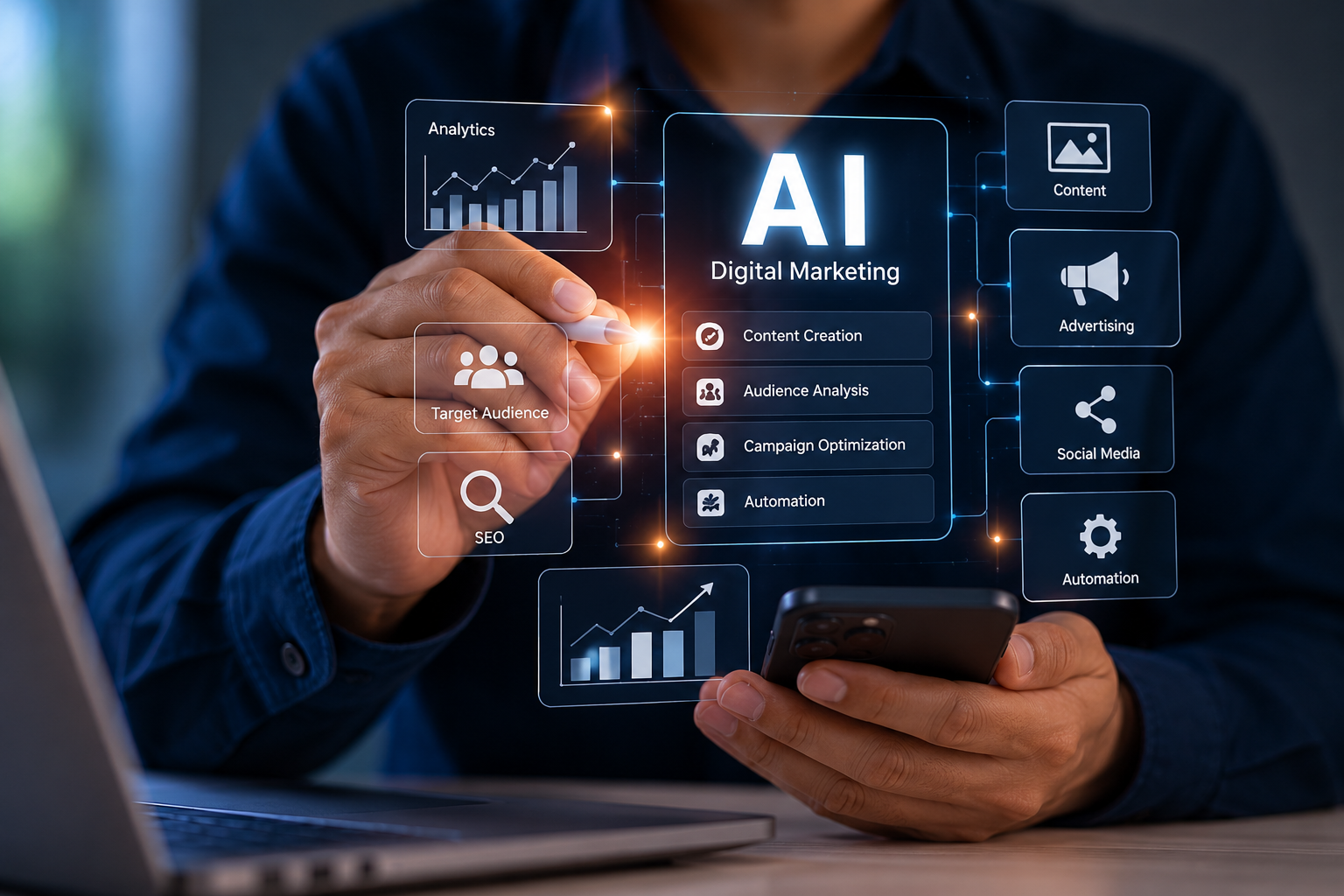
Artificial intelligence (AI) is changing how businesses approach digital marketing. From analyzing customer behavior to automating repetitive tasks, AI offers opportunities to improve efficiency, personalize customer experiences, and make more informed marketing decisions.
However, adopting AI is not simply about using new tools. Businesses need to understand where the technology can create value and how it fits into their existing marketing strategy.
Integrating AI into your digital marketing strategy starts with identifying business needs, setting clear objectives, and using technology to support better decisions.
Why AI Matters in Digital Marketing
Traditional marketing strategies often require significant time and resources to analyze data, segment audiences, create content, and measure campaign performance. AI can help streamline these activities and identify patterns that might otherwise be difficult to detect.
For businesses, the main advantage is not automation alone. It is the ability to combine data, creativity, and technology to deliver more relevant marketing experiences.
AI can help companies:
Analyze customer behavior and identify emerging trends.
Personalize marketing messages and customer journeys.
Generate ideas for content and advertising campaigns.
Automate repetitive marketing tasks.
Improve audience segmentation and campaign optimization.
Make faster, data-informed decisions.
The value of AI depends on how effectively businesses apply these capabilities to their specific goals. A company seeking more qualified leads, for example, may benefit from AI-powered lead analysis, while an ecommerce business might prioritize product recommendations and personalized customer communications.
1. Start with Clear Marketing Objectives
Before implementing AI tools, define what you want to achieve. Technology should support your business objectives rather than become an objective in itself.
Consider the main challenges affecting your marketing performance. Are you struggling to attract new customers? Is your team spending too much time producing content? Are your campaigns generating traffic but few conversions?
Once you identify the problem, establish measurable goals.
For example, your objectives might include improving lead quality, reducing the time required to produce marketing content, increasing email engagement, or identifying which acquisition channels generate the best return.
Clear objectives make it easier to choose suitable tools, evaluate results, and determine whether AI is delivering meaningful business value.
2. Use AI to Understand Your Audience
Understanding your audience is fundamental to any successful digital marketing strategy. AI can help analyze customer interactions, survey responses, website behavior, and campaign performance to identify patterns in customer needs and preferences.
These insights can support more relevant audience segmentation and help marketing teams develop messages that address specific challenges.
For example, a business offering professional services could use AI to organize common customer questions and identify recurring concerns. The marketing team could then develop targeted landing pages, educational articles, or email campaigns around those topics.
However, AI-generated insights should be validated against reliable data. Incomplete information or biased assumptions can lead to inaccurate conclusions, so human review remains essential.
3. Improve Content Marketing with AI
Content marketing is one of the areas where AI can support marketing teams throughout the creative process.
AI tools can help with keyword research, topic discovery, content outlines, headline variations, content repurposing, and editorial planning. They can also help adapt existing content for different channels, such as turning a blog article into social media posts or an email newsletter.
For example, a company publishing an article about customer retention could use AI to identify related topics, suggest questions for a frequently asked questions section, and generate ideas for LinkedIn posts.
Nevertheless, AI should support the creative process rather than replace the company’s expertise and original perspective.
Generic content can make a brand less distinctive. Businesses should review AI-generated material for accuracy, originality, tone of voice, and relevance before publishing it.
The strongest approach combines AI-assisted production with human insight, industry knowledge, and a clear understanding of the target audience.
4. Personalize Customer Experiences
Customers expect relevant communication across websites, email, social media, and other digital channels. AI can help businesses deliver more personalized experiences by analyzing available customer data and identifying differences in behavior or interests.
Depending on the tools and data available, companies can use AI to recommend relevant products, adapt email content to customer segments, or provide more contextual support through chatbots.
For example, an online retailer could recommend products based on a customer’s previous interactions, while a B2B company could tailor educational content to the needs of different decision-makers.
Personalization must be handled responsibly. Businesses should respect privacy requirements, obtain appropriate consent where necessary, and avoid using personal information in ways customers would not reasonably expect.
5. Automate Repetitive Marketing Tasks
Marketing teams often spend considerable time on routine activities, including organizing leads, preparing reports, scheduling communications, and updating campaign information.
AI and marketing automation tools can help reduce this workload, allowing teams to focus more on strategy, creative development, and customer relationships.
Businesses might automate lead classification, draft responses to common inquiries, summarize campaign results, or trigger email sequences based on defined customer actions.
Automation should always include appropriate safeguards. Important customer communications, sensitive decisions, and high-impact actions may require human approval.
The objective is to improve efficiency without sacrificing quality or the personal relationships that contribute to long-term customer loyalty.
6. Measure Performance and Optimize Campaigns
Integrating AI into digital marketing is an ongoing process. Businesses should evaluate whether their initiatives are improving performance rather than assuming that using advanced technology will automatically produce better results.
Track metrics that reflect your original objectives, such as qualified leads, conversion rates, customer acquisition costs, email engagement, and time saved on marketing activities.
Compare results against a baseline established before implementation. Where possible, use controlled experiments to understand whether a change actually improves outcomes.
For example, you could test two versions of an email subject line or compare an AI-assisted workflow with your existing process. The results can help you decide whether to expand the initiative, adjust it, or discontinue it.
7. Establish Responsible AI Practices
Successful AI adoption requires more than selecting the right software. Companies also need clear guidelines for how their teams use it.
Establish internal standards for reviewing AI-generated content, protecting confidential information, verifying factual claims, and complying with applicable privacy and data protection regulations.
Employees should understand which tasks AI can support, which decisions require human judgment, and how to identify errors or unreliable outputs.
Businesses should also evaluate the security, transparency, and suitability of the tools they adopt. Not every AI application is appropriate for every business process.
A responsible approach builds trust while allowing organizations to explore new opportunities.
Turning AI into a Competitive Advantage
AI can strengthen digital marketing by helping businesses understand their audiences, develop more relevant content, automate routine activities, and optimize campaign performance.
The most effective approach is to start with a specific business challenge, choose tools that address it, and measure the results. From there, companies can expand successful initiatives while refining their processes and developing their teams’ capabilities.
AI should not replace marketing strategy. It should make that strategy more informed, efficient, and adaptable.
Businesses that combine useful technology with human creativity, critical thinking, and a strong understanding of their customers will be better positioned to build meaningful relationships and achieve sustainable digital growth.